(Correspondent: Cheng Ran) At the invitation of our university, Researcher Qing Guangyan from the Dalian Institute of Chemical Physics, Chinese Academy of Sciences, visited our university for exchange and access on October 13, 2026, and delivered an academic report titled "Precise Separation and Analysis of Glycans" in Meeting Room 305 of the School of Chemistry and Environmental Engineering, Northwest District Office Building. The report was chaired by Dean Yu Junxia of the School of Chemistry and Environmental Engineering, and relevant faculty and students of the school attended the meeting.
Researcher Qing Guangyan took the key role of glycans in life activities as the starting point and elaborated in depth on the significance of precise separation and analysis of glycans for glycobiology and disease biomarker research. He pointed out that glycans have complex structures, diverse linkage modes, and a large number of isomers, and that their highly selective recognition and efficient separation have long been a difficulty in the field of analytical chemistry. In response to this challenge, Researcher Qing Guangyan introduced his team's innovative ideas in biomolecule-responsive polymer materials, chiral functional surfaces, and polymer-based enrichment materials and devices for post-translational modification proteomics, providing new technical pathways for highly sensitive and high-resolution analysis of glycans in complex biological systems.
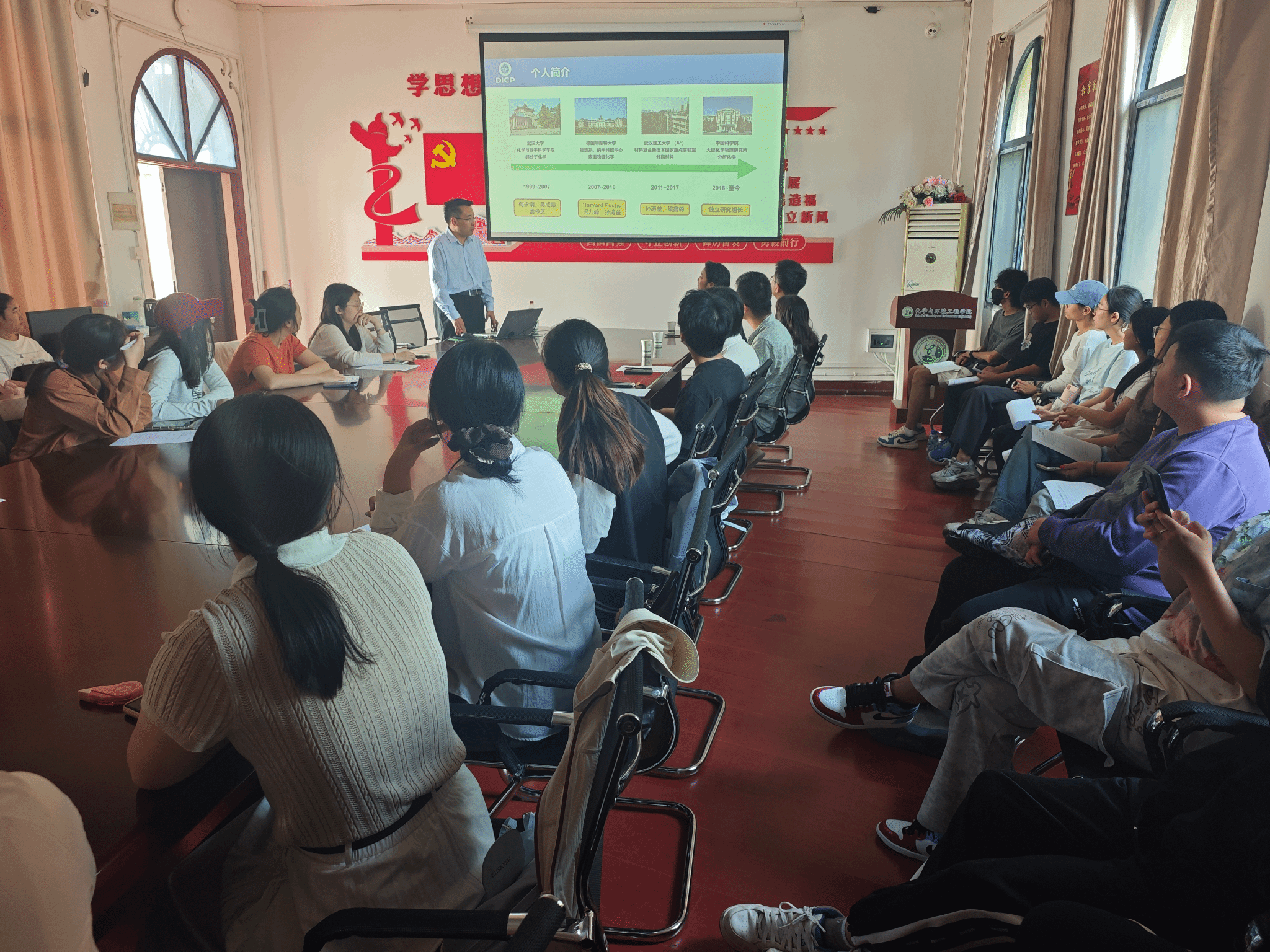
In the report, Researcher Qing Guangyan focused on introducing a series of research advances made by his team: by constructing responsive polymer materials with recognition ability for specific glycans, selective capture and release of glycans were achieved; chiral functional surfaces were used to efficiently distinguish glycan isomers, significantly improving the resolution of isomers; at the same time, in response to the needs of post-translational modification proteomics, a series of polymer-based enrichment materials and devices were designed and prepared, providing a powerful means for high-throughput analysis of complex samples such as glycoproteins. These results not only promoted innovation in bioseparation and analysis methods, but also provided important support for the discovery and detection of related disease biomarkers. In addition, he also looked forward to the broad prospects of precise separation and analysis of glycans in fields such as life sciences, clinical diagnosis, and biomedicine, and encouraged young students to bravely challenge interdisciplinary problems and contribute wisdom to the scientific frontier.
At the end of the report, Researcher Qing Guangyan engaged in in-depth discussions with faculty and students on design strategies for glycan separation materials, technical application scenarios, and other topics. His rigorous academic attitude and vivid answers won applause from the audience. This report not only broadened faculty and students' understanding of the field of bioseparation and analysis, but also stimulated everyone's enthusiasm for basic scientific research, injecting new ideas into the development of related disciplines at our university.
Expert Profile:
Qing Guangyan received his bachelor's, master's, and doctoral degrees in organic chemistry from the College of Chemistry and Molecular Sciences of Wuhan University. He is currently a researcher and independent research group leader in the Department of Biotechnology at the Dalian Institute of Chemical Physics, Chinese Academy of Sciences, and is mainly engaged in bioseparation and analysis research. He has developed a series of biomolecule-responsive polymer materials, chiral functional surfaces, and polymer-based enrichment materials and devices for post-translational modification proteomics. As first or corresponding author, he has published 155 SCI papers in internationally renowned journals such as Nat. Commun., Adv. Mater., J. Am. Chem. Soc., Angew. Chem. Int. Ed., Sci. Adv., and Chem. Soc. Rev., with more than 5,000 citations. He has filed 53 national invention patents, of which 28 have been authorized. He has presided over 4 General Projects of the National Natural Science Foundation of China, 1 Youth Science Fund Project, and subprojects of the Ministry of Science and Technology's 973 Major Research Plan and Key R&D Program, with cumulative funding of 25 million yuan. As first completer, he won the First Prize of the 2025 Analytical Testing Science Award and received funding from the Category A of the National Natural Science Foundation of China Youth Science Fund in 2026. He has also won the First Prize of Hubei Provincial Natural Science Award and funding from the Hubei Provincial Outstanding Youth Fund, and has been selected for honors such as Hubei Province Chutian Scholar Distinguished Professor, Liaoning Province "Xingliao Talent Plan" Innovation Leading Talent, Liaoning Province Hundred-Thousand-Ten Thousand Talent Project "Thousand" Level, and Dalian Outstanding Youth Science and Technology Talent. He serves as a member of the Chromatography Professional Committee of the Chinese Chemical Society, a member of the Nanoanalysis and Chromatography Professional Committee of the China Association for Instrumental Analysis, and an editorial board member of Chinese Journal of Chromatography and Chin. Chem. Lett. (Reviewed by Zhao Qingbiao)
