(Reported by our website, Correspondent: Jia Fengcheng) Recently, Yu Shiyue, a 2022 undergraduate student majoring in Applied Chemistry, Hu Jian, a 2023 undergraduate student, and Ke Ziyi, a 2023 undergraduate student majoring in Environmental Engineering from the School of Chemistry and Environmental Engineering of our university, each published academic papers as first authors in the international academic journals in the field of analytical chemistry, Microchemical Journal and Microchimica Acta, totaling 3 papers. Wuhan Institute of Technology is the first affiliated and corresponding institution, and the supervising teachers and corresponding authors of the papers are Associate Professor Tang Sheng and Professor Chen Wei from the School of Chemistry and Environmental Engineering. The papers were supported by the National Natural Science Foundation of China (No. 21906124), the Hubei Provincial Natural Science Foundation (No. 2017CFB220), the Hubei Provincial New Engineering Course Construction Project (XGK01057), and the National College Students' Innovation and Entrepreneurship Training Program (No. 202510490012, No. 202610490019).
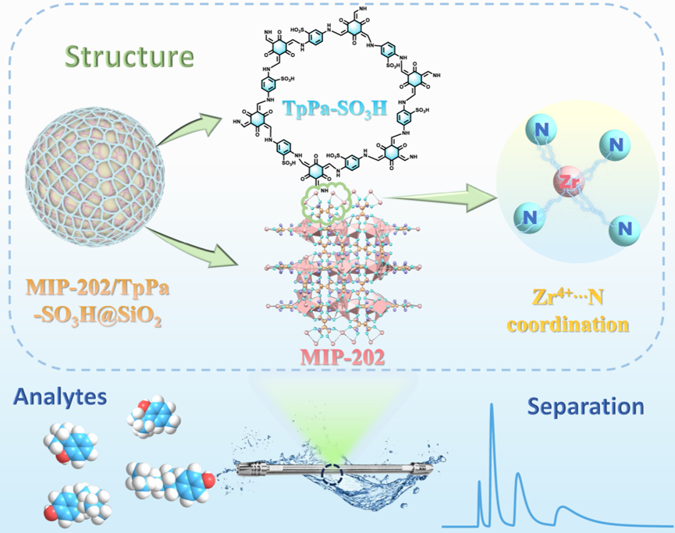
Yu Shiyue, a 2022 undergraduate student, published a paper titled "Facile green synthesis of sulfonated COF-MOF hybrid silica stationary phase for versatile liquid chromatographic separation" in Microchemical Journal (a Tier 2 TOP journal). The paper proposed a green and innovative synthesis strategy, successfully co-modifying a green MOF (MIP-202) prepared under organic-solvent-free conditions and an ionic COF (TpPa-SO3H) onto the surface of silica microspheres to construct a novel MIP-202/TpPa-SO3H@SiO2 chromatographic stationary phase. The entire synthesis process used water or environmentally friendly deep eutectic solvents as reaction media, avoiding the use of traditional organic solvents. The introduction of TpPa-SO3H not only enhanced the hydrophobicity of MIP-202, effectively compensating for its insufficient separation ability for hydrophobic substances, but also served as a "bridge" in the MOF/COF composite material, stabilizing the overall structure and increasing porosity to reduce column pressure and improve permeability. Benefiting from this, the stationary phase is compatible with mobile phase systems with high water content, significantly reducing the consumption of organic phases and providing a new pathway for developing green liquid chromatography technology. The research results showed that the stationary phase integrates multiple retention mechanisms and exhibits excellent separation performance for hydrophilic, hydrophobic, and chiral compounds, providing a reliable method for the efficient detection of multiple types of analytes in complex samples. This work fully demonstrated the unique advantages of MOF/COF composite materials in chromatographic analysis and provided new ideas for the further expanded application of porous materials in the field of separation science.
Full-text link:
https://www.sciencedirect.com/science/article/abs/pii/S0026265X26002602
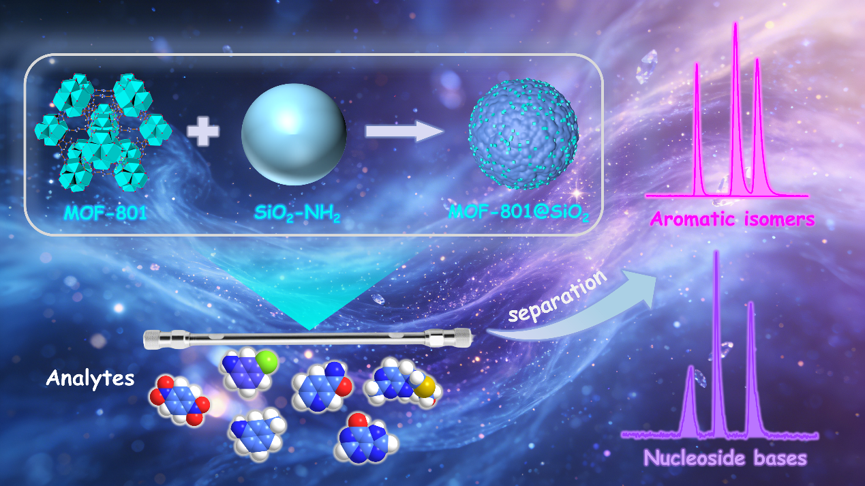
Hu Jian, a 2023 undergraduate student, published a paper titled "Room-temperature aqueous synthesis of MOF-801@SiO2 stationary phase: A green chromatographic material with multiple separation modes" in Microchemical Journal (a Tier 2 TOP journal). The paper developed an environmentally friendly and mild synthesis route, successfully achieving the preparation of a novel MOF-801@SiO2 stationary phase. In this method, silica microspheres were first amino-functionalized in a deep eutectic solvent, then grafted with fumaric acid, and finally MOF-801 was grown in situ at room temperature with water as the main solvent. Unlike most reported synthesis routes for MOF@SiO2 stationary phases, this strategy required no high temperature, high pressure, or toxic organic solvents throughout the process, and achieved MOF functionalization on the silica surface in a room-temperature aqueous system, fully embodying the concept of green chemistry. Chromatographic performance evaluation showed that the prepared MOF-801@SiO2 stationary phase can be applied to mixed-mode chromatography and exhibits excellent separation ability for positional isomers, nucleosides, vitamins, and sulfonamide drugs. In addition, the stationary phase was successfully used for the detection of antibiotics in lake water, verifying its practical application potential in environmental water sample analysis. This study provides a practical and green new approach for the room-temperature aqueous synthesis of high-performance MOF@SiO2 stationary phases, effectively expanding the application prospects of MOF-based composite materials in the field of chromatographic separation.
Full-text link:
https://www.sciencedirect.com/science/article/abs/pii/S0026265X26015821
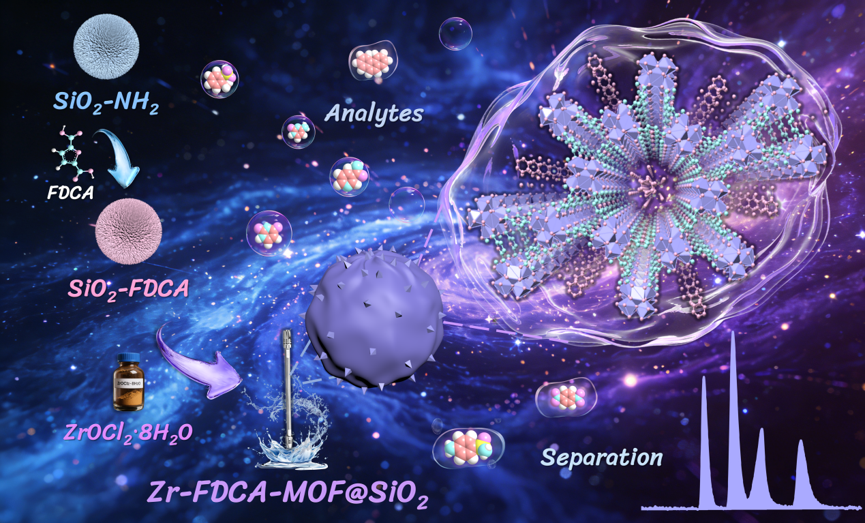
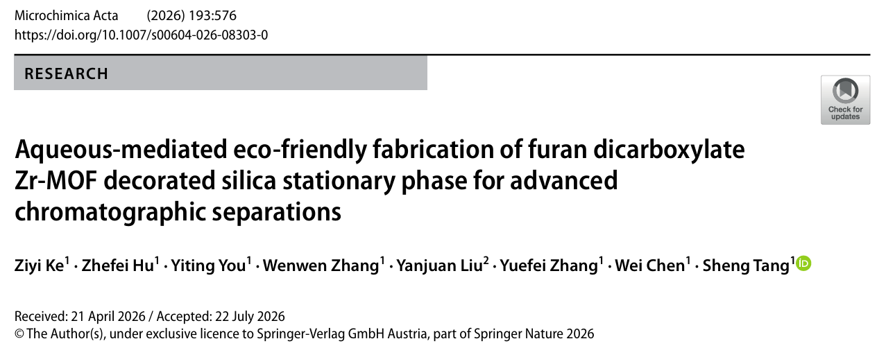
Ke Ziyi, a 2023 undergraduate student, published a paper titled "Aqueous-mediated eco-friendly fabrication of furan dicarboxylate Zr-MOF decorated silica stationary phase for advanced chromatographic separations" in Microchimica Acta (a Tier 2 TOP journal). The paper adopted a green and simple strategy, using water as the main solvent, combining room-temperature stirring and water-bath heating, and selecting renewable 2,5-furandicarboxylic acid (FDCA) as the organic ligand to develop a novel Zr-FDCA-MOF@SiO2 stationary phase. The research showed that the stationary phase exhibits excellent multi-mode separation compatibility. By integrating multiple retention mechanisms such as hydrophilic, hydrophobic, hydrogen bonding, π-π, and ion exchange into a single stationary phase, it not only significantly improved the flexibility of separation operations, but also enabled customized separation with tunable performance for different types of analytes such as hydrophilic, hydrophobic, and aromatic isomers. Of particular note, the stationary phase can operate stably in water-rich liquid chromatography modes, a feature that significantly reduces the consumption of organic solvents and aligns with the development concept of green chromatography. In summary, the Zr-FDCA-MOF@SiO2 stationary phase combines multi-mode compatibility and environmental sustainability, has broad application prospects in complex sample analysis, and provides a new direction for expanding the application of renewable-ligand-derived MOFs in separation science.
Full-text link:
https://link.springer.com/article/10.1007/s00604-026-08303-0
For a long time, the School of Chemistry and Environmental Engineering has relied on innovation and entrepreneurship projects at the national, provincial, and university levels to build a scientific research practice platform for undergraduate students, continuously deepening the integration of science and education and collaborative education. Relying on a complete interdisciplinary system of chemistry and environment, the school encourages undergraduate students to focus on frontier topics and actively devote themselves to scientific research exploration and innovative practice.
In the next step, the school will continue to improve the two-way selection and tracking cultivation mechanism for undergraduate students, further broaden the coverage of education and optimize the educational environment with the help of disciplinary platforms and high-quality faculty, comprehensively enhance the comprehensive scientific research innovation literacy of undergraduate students, use high-quality science-education integration results to promote the improvement of the school's talent cultivation quality and efficiency, and consolidate the talent foundation for the university's double first-class construction. (Reviewed by Yu Junxia)
