(Correspondent: Cheng Ran) Recently, a graduate student supervised by Professor Cheng Gang from the School of Chemistry and Environmental Engineering of Wuhan Institute of Technology published a research paper titled "Integrating S-scheme heterojunction with interfacial metal-sulfur bonds promotes solar-to-hydrogen evolution in TiO2@Pd-doped ZnIn2S4 core@shell photocatalysts" in the international top journal Advanced Functional Materials (a CAS Tier 1 TOP journal with an impact factor of 19.9). Wuhan Institute of Technology is the first affiliated institution of the paper, with 2024 graduate student Yu Wenjie as the first author and Professor Cheng Gang as the corresponding author. Wuhan Textile University and Central South University also participated in this research.

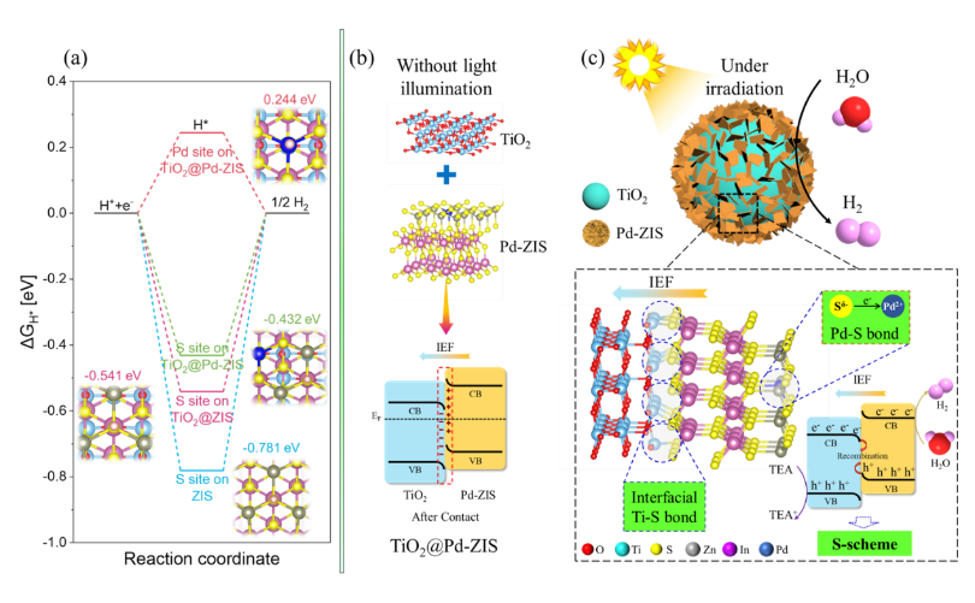
The development of clean energy is a core direction of the global energy transition. In response to the shortcomings of photocatalytic materials for solar hydrogen production, such as low photogenerated carrier separation efficiency and a lack of catalytic active sites, as well as the key issue of how to construct a multi-pathway charge transport catalytic system at the atomic scale, the research focuses on the strategy of S-scheme heterojunctions coupled with metal-sulfur bond-induced photogenerated charge separation, and constructs TiO2@Pd-doped ZnIn2S4 core@shell composite materials. The S-scheme heterojunction and Pd doping are used to synergistically optimize charge transport behavior and hydrogen adsorption reaction kinetics: on the one hand, the Ti-S bonds at the heterointerface and the lattice Pd-S bonds work together to build directional high-speed charge transport pathways; on the other hand, Pd doping can broaden the visible-light response range of the material, strengthen the interfacial built-in electric field, and introduce abundant new hydrogen adsorption active sites. The dual modification mechanism synergistically lowers the energy barrier of the hydrogen evolution reaction, significantly optimizing the catalytic reaction kinetics and enhancing the photocatalytic reaction process.
In recent years, the university has continuously promoted the construction of "first-class disciplines" through multiple measures and actively advanced scientific research innovation and the output of high-level achievements. The publication of this achievement further reflects the new results achieved in the construction of the university's chemistry discipline, helps enhance the international academic visibility and influence of chemistry and related disciplines, and provides strong support for the construction of "first-class disciplines." (Reviewed by Chen Yunfeng)
