(Reporters: Yang Zi, Yan Fei) To implement the requirements of the "Notice on Holding the Wuhan Institute of Technology Education and Teaching Achievement Exhibition and the 13th 'University Academic Week' Series of Activities" issued by the Undergraduate School, and to further broaden the academic horizons of our undergraduates, strengthen their research literacy, and cultivate innovative thinking, our college invited Professor Lang Xianjun from Wuhan University to give a lecture. On April 15, 2026, in Classroom 1408 of Teaching Building No. 1, Professor Lang delivered a special academic report titled "Photocatalytic Selective Chemical Transformation Reactions of Crystalline Porous Materials." The lecture was hosted by Associate Dean Li Junbo of the college, and was attended by relevant faculty members and all 2024 undergraduate students.
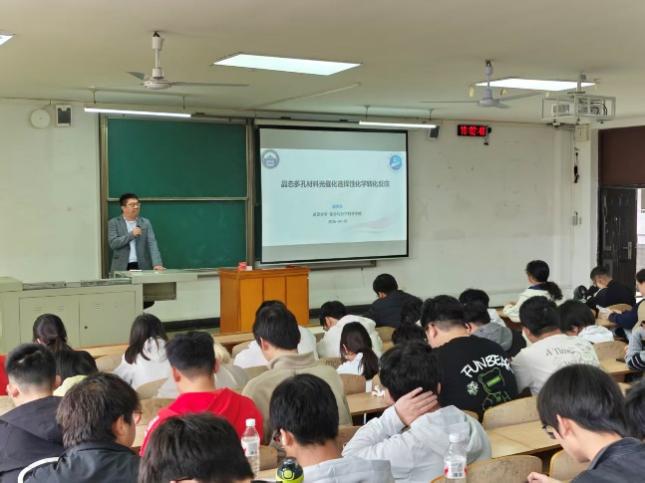
Professor Lang Xianjun systematically outlined the development trajectory, current research hotspots, and future directions of crystalline porous materials, integrating the latest domestic and international research progress, thereby constructing a systematic academic cognitive framework for the students. Subsequently, Professor Lang focused on the synergistic catalytic strategy combining TEMPO (2,2,6,6-tetramethylpiperidine-N-oxyl) and Covalent Organic Frameworks (COFs). He explained how this strategy organically integrates the unique structural advantages of COFs with the excellent catalytic performance of TEMPO, providing new ideas for achieving efficient and highly selective organic transformations. Furthermore, he elaborated on the construction method of sp²c-COFs based on chemical regulation design. He compared the significant advantages of sp²c linkages over imine linkages in regulating band structure and accelerating charge migration, which endow sp²c-COFs with outstanding performance in photocatalytic selective reactions. He also analyzed in depth the mechanistic roles of superoxide radicals and singlet oxygen within the reaction system. At the end of the report, Professor Lang shared practical tips on research topic selection, experimental design, and problem-solving based on his years of research experience. He encouraged students to stay grounded in their major, be brave in exploration, diligent in thinking, maintain enthusiasm for scientific research, and cultivate rigorous research habits and solid practical skills.
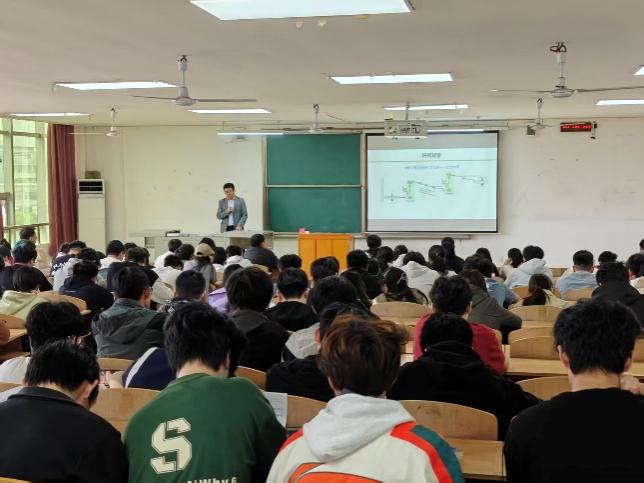
Professor Lang Xianjun's presentation sparked significant interest and lively discussion among the students. During the interactive session, he provided detailed responses and engaged in in-depth discussions regarding student questions about the application of AI in the study of crystalline porous materials. He guided students to adapt to the trends of the times, progress alongside technology, and encouraged them to think critically and broaden their research perspectives.
The successful holding of this academic report, on the one hand, closely integrated research achievements in the frontier catalytic field of crystalline porous materials with the teaching and research of Chemistry and Environmental Engineering. It effectively broadened the students' academic horizons, helped them understand the development trends of interdisciplinary integration, and pointed out new directions and provided new ideas for their future professional studies and academic exploration. On the other hand, it further cultivated the scientific research thinking of the undergraduates, effectively stimulated their interest in research and innovative drive, and guided them to firmly establish the professional philosophy of "green development, technology empowerment," thereby laying a solid foundation for the college's talent cultivation efforts.
Reviewed by Li Junbo
Brief Introduction to Professor Lang Xianjun:
Professor Lang Xianjun is a doctoral supervisor and an independent research group leader. He received his Ph.D. from the Institute of Chemistry, Chinese Academy of Sciences in 2011, under the supervision of Academician Zhao Jincai. From 2011 to 2015, he conducted postdoctoral research at Nanyang Technological University in Singapore, working with Professor Chen Xiaodong. He began his independent research career in July 2015. As first author and corresponding author, he has published numerous high-impact papers, including in Angew. Chem. Int. Ed. (3 papers), Chem. Sci. (2 papers), Chem. Soc. Rev. (2 papers), and Acc. Chem. Res. (1 paper). He has also authored 3 book chapters (1 published by RSC, 1 by Wiley, 1 by Elsevier). His publications have been cited over 10,000 times, with a single paper cited over 1,000 times, and he has 6 ESI Highly Cited Papers. In 2023, he received the Young Scientist Award at the National Conference on Solar Photochemistry and Photocatalysis. In 2025, he was named an Emerging Scientist by Science China Materials. His main research directions include: framework material photocatalysis; molecular oxygen activation and utilization.
